

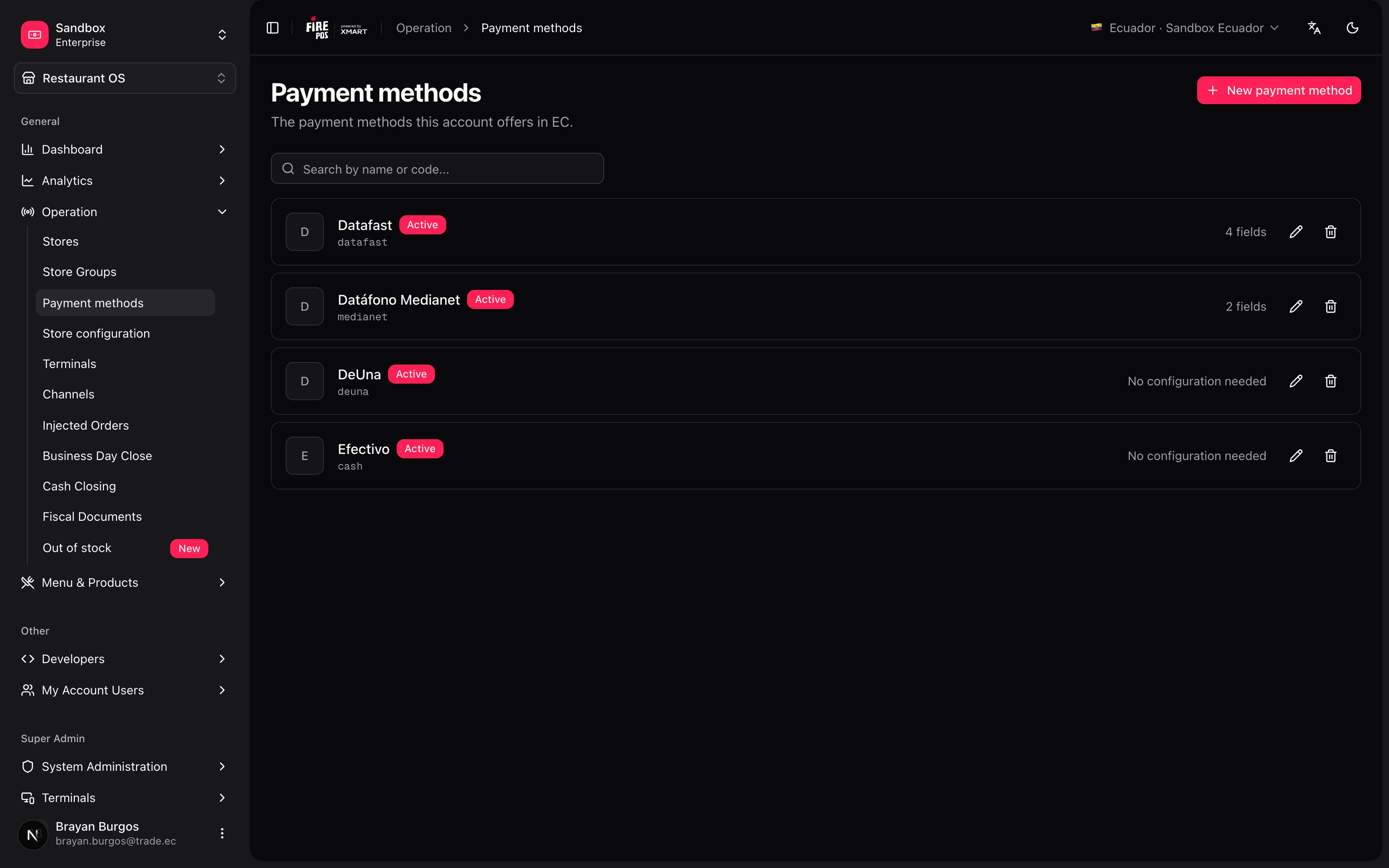
The short version
1. The code is a contract, and it’s permanent. Channels reference the method by its
code, so once you save it you can’t change it. The name you can rename any time.2. Every method declares its own fields, and at which level each one is filled. Account, Store or Terminal. That decision is what the store screen reads to know what to ask for.3. Turning a method off is reversible. Deleting it is not. Active off stops charging everywhere and keeps everything. Delete cannot be undone: creating the method again starts from an empty configuration.The simple path
If you only take cash, this takes a minute.- New payment method.
- Name:
Cash. The Code fills itself in ascashwhile you type. - Check This method does not take cards.
- Save.
The code is the contract
While you type the name, Fire derives the Code from it: lowercase, no accents, no spaces, underscores instead. You can overwrite it — a provider may demand an exact spelling — but the moment you save, the code is locked. That’s deliberate. The code is the identifier channels use to refer to the method: kiosks, the POS, aggregators. Renaming Datafast to Datafast EC changes what the customer reads on screen and nothing else. The code staysdatafast and everything downstream keeps working.
Two consequences worth knowing before you save:
- A typo in the code is permanent. Getting
datafstin production means creating a new method and reconfiguring every store that used the old one. - The code is unique per country. Trying to reuse one gets you “A payment method with that code already exists in this country”. The same code in Ecuador and in Brazil is fine — they’re separate methods.
Configuration fields: what the method needs, and who fills it in
This is the section that pays for itself. Under Configuration fields you declare, one row per piece of data, what this method needs in order to charge.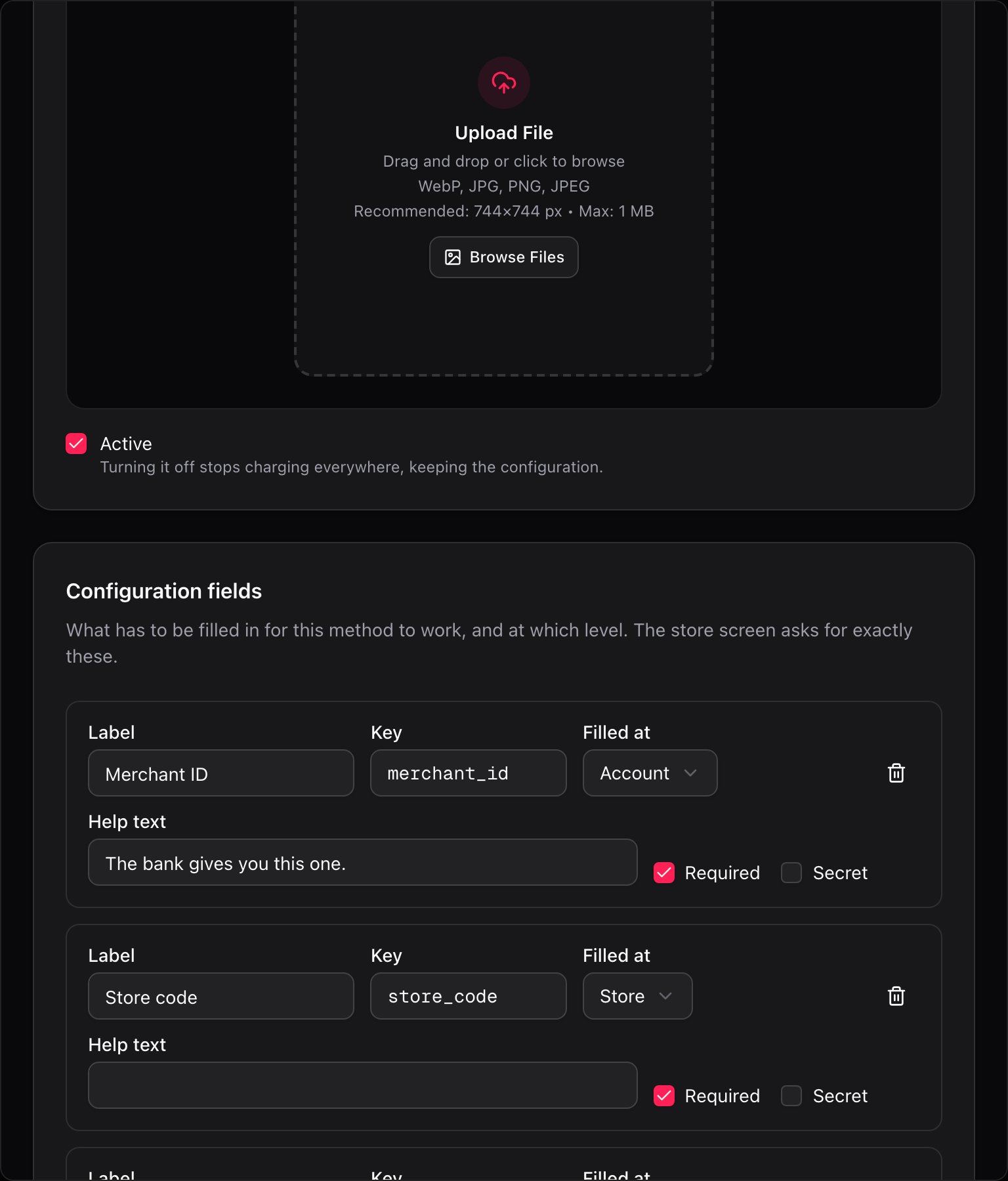
The three levels
Filled at decides who gets asked for the value, and where:
At charge time the three levels are merged and the most specific one wins: terminal over store, store over account. That’s what lets one kiosk have its own pinpad IP without erasing the store’s.
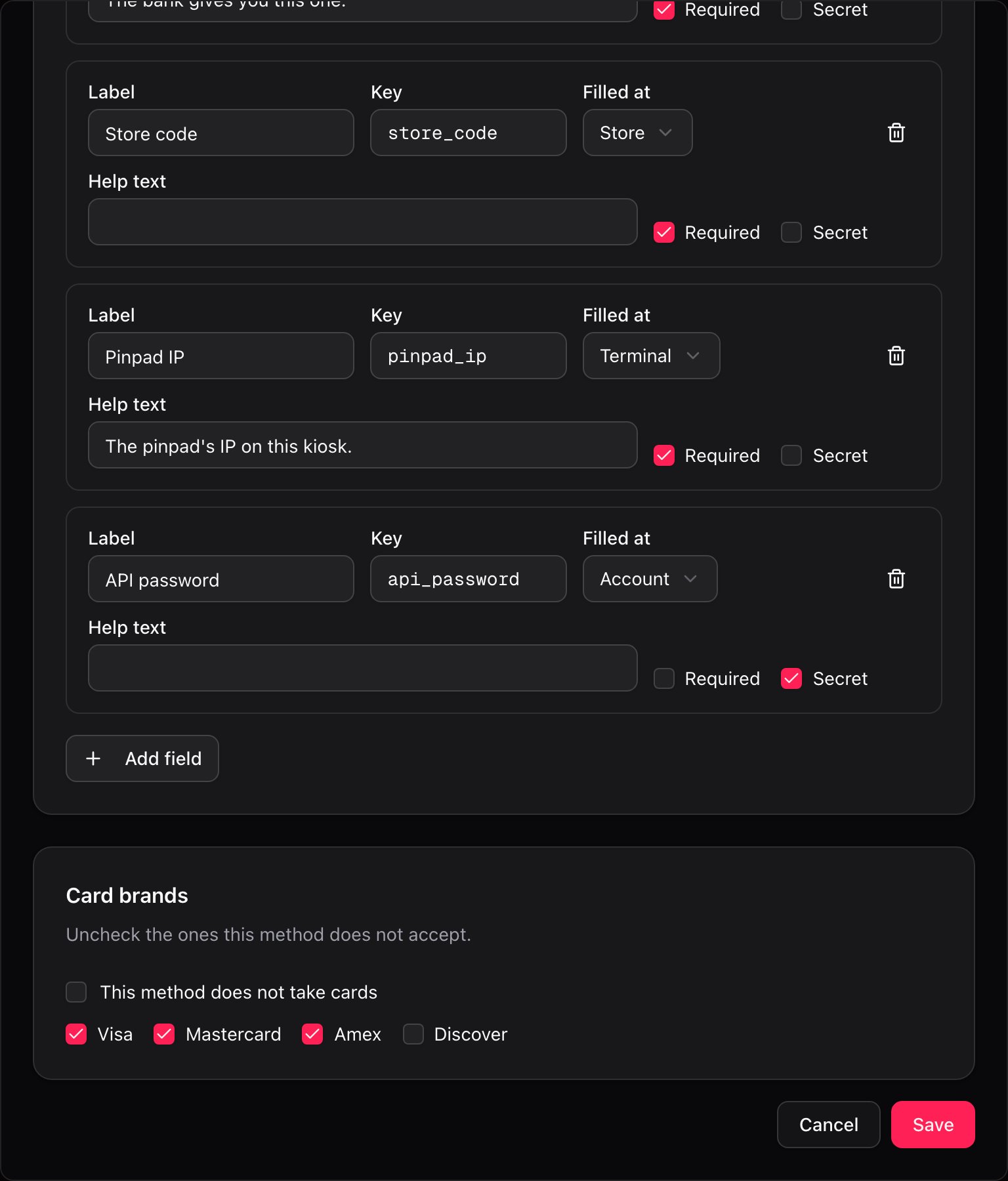
Card brands
The logo
The logo is what the customer sees at checkout on channels that render it. You upload it by opening a method that already exists — the field isn’t there while you’re creating it.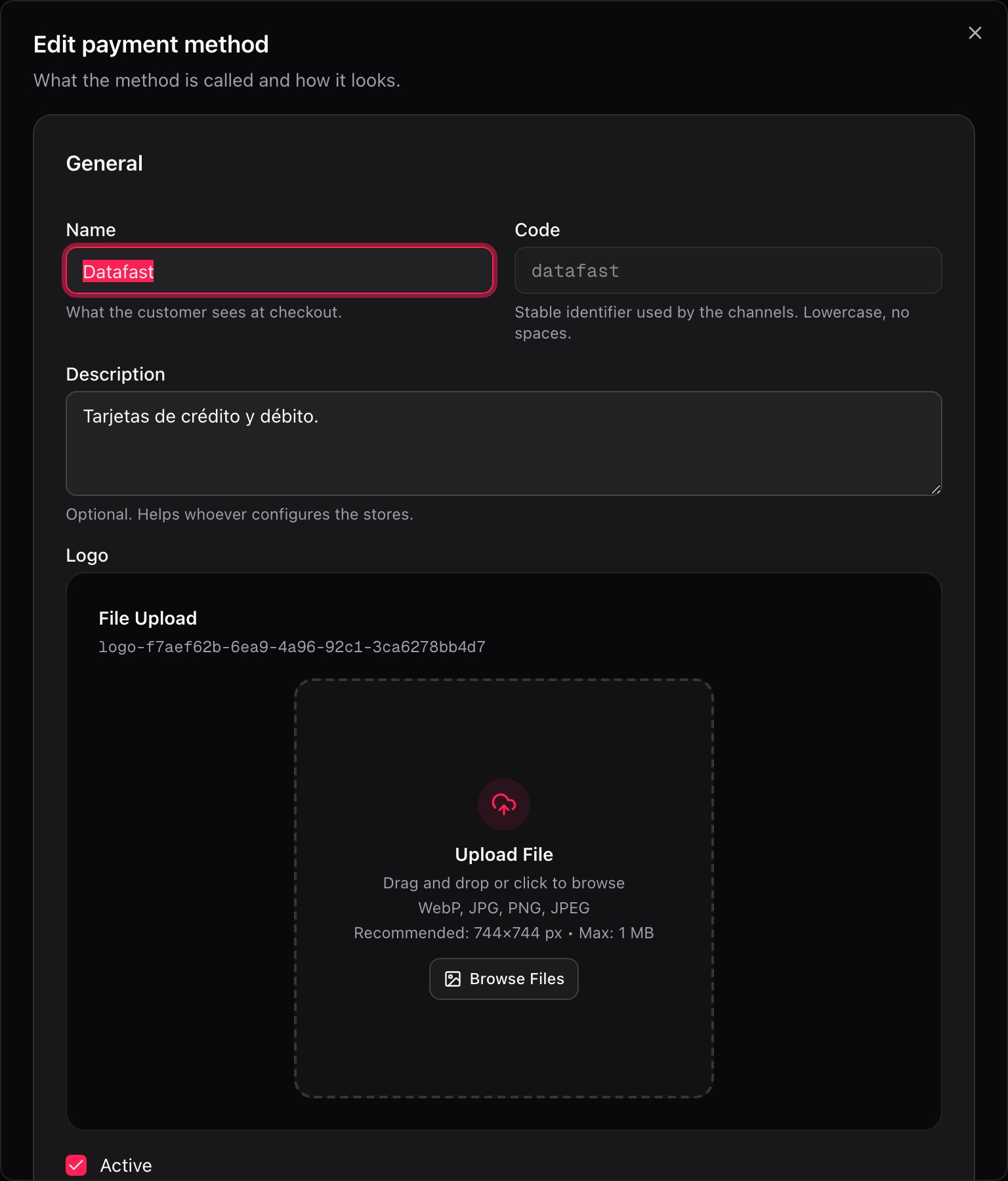
Turning it off is not deleting it
Two different actions that people confuse under pressure, when a processor has just gone down. Unchecking Active stops that method from charging everywhere, and keeps every store’s configuration exactly as it was. When you check it again, Fire brings back only what the deactivation switched off — anything that was already paused by hand stays paused. It’s the reversible one, and it’s the right one for an outage. Delete removes the method from the list for good.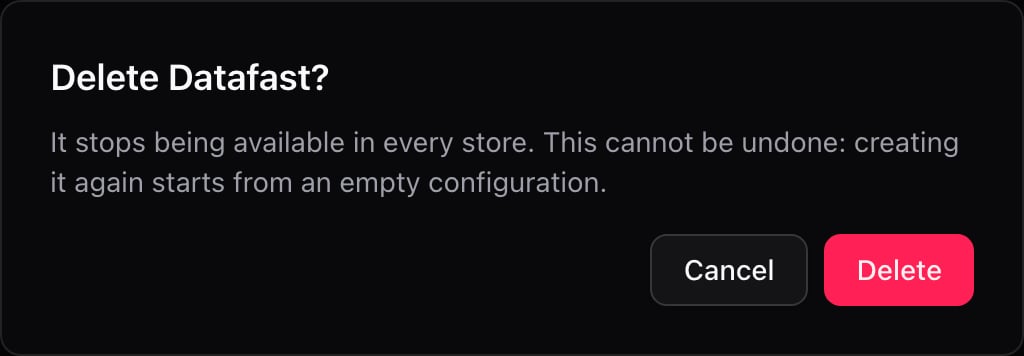
Recipes: how to handle real-world cases
Set up cash
Set up cash
- New payment method → Name
Cash. - Check This method does not take cards.
- Save.
Set up a card processor with a pinpad per kiosk
Set up a card processor with a pinpad per kiosk
The bank gives you one merchant ID, each store has its own code and each kiosk has its own pinpad.
- New payment method → Name
Datafast, codedatafast. - Leave the card brands the processor takes checked.
- Add field three times:
merchant_id— Filled at Account, Requiredstore_code— Filled at Store, Requiredpinpad_ip— Filled at Terminal, Required, help text “The pinpad’s IP on this kiosk.”
- Save.
Set up an online gateway with a single credential
Set up an online gateway with a single credential
A gateway that authenticates once for the whole account and needs nothing per store.
- Create the method with its name and brands.
- Add field twice, both Filled at Account:
api_key— Required, Secretapi_password— Secret
- Save.
The processor is down and you need to stop charging with it
The processor is down and you need to stop charging with it
- Open the method.
- Uncheck Active.
- Save.
Whatever someone had paused by hand before the outage stays paused. Reactivating doesn’t undo human decisions.
Change providers keeping the same code
Change providers keeping the same code
If the new provider needs different data but you’d rather not touch every channel that references the code:
- Open the method and edit its Configuration fields — add what the new provider asks for, remove what it no longer uses.
- Rename it if the customer-facing name changes.
- Reload the values in store configuration.
One method, followed end to end
datafast, with its four fields, across a chain with two stores and three kiosks:
Six values in total. Had all four been declared at Store level, the same setup would take eight, two of them copy-pasted identically and one of them wrong the day someone mistypes it. Had
pinpad_ip been declared at Account level, the three kiosks would share one IP and two of them would never charge.
The level isn’t a formality: it’s how many times someone has to type the value, and how many chances there are to get it wrong.
Mistakes that cost money
Glossary
Frequently asked questions
Can I change the code after saving?
Can I change the code after saving?
No. It’s locked because channels already reference it. What you can change is the Name, as often as you like — that’s what the customer sees.
I deleted a method by mistake. Can I get it back?
I deleted a method by mistake. Can I get it back?
Not from the app. Creating it again — even with the same code — produces a new method with an empty configuration: the values loaded across your stores and terminals are not reconnected. If you needed a pause, the reversible action was unchecking Active.
Why doesn't a method appear in a store?
Why doesn't a method appear in a store?
Existing here isn’t the same as being offered there. Availability is decided per store, channel and fulfillment in store configuration. Check as well that the method is Active and that its country matches the store’s.
What does marking a field as Secret change?
What does marking a field as Secret change?
It hides the value on screen while it’s typed, the way a password field does. It’s a display aid for whoever is loading it, not an encryption guarantee — treat it as such when you decide what to put in there.
Do the methods from one country show up in another?
Do the methods from one country show up in another?
No. A method belongs to an account and a country. The screen always shows the methods for the country selected in the header, which is why the same code can exist in two countries as two separate methods.
Can I reorder the list?
Can I reorder the list?
Not yet. The list is ordered alphabetically by name. If order matters to you, the name is the lever you have.
What’s coming
Things this screen does not do today, so nobody promises them:- No restore of a deleted method. Deleting is final, as the dialog says.
- No duplicating a method, and no copying methods from one country to another.
- No manual ordering of the list.
- No data types on configuration fields: everything is captured as text. There’s no number, boolean, dropdown or format validation.
- Card brands are the four listed ones. Local brands can’t be added.
- The logo is uploaded by editing, never while creating the method.
- Changes here don’t tell you whether every kiosk received them. If a kiosk was offline when you renamed or deactivated a method, the warning shows up in store configuration, not here.